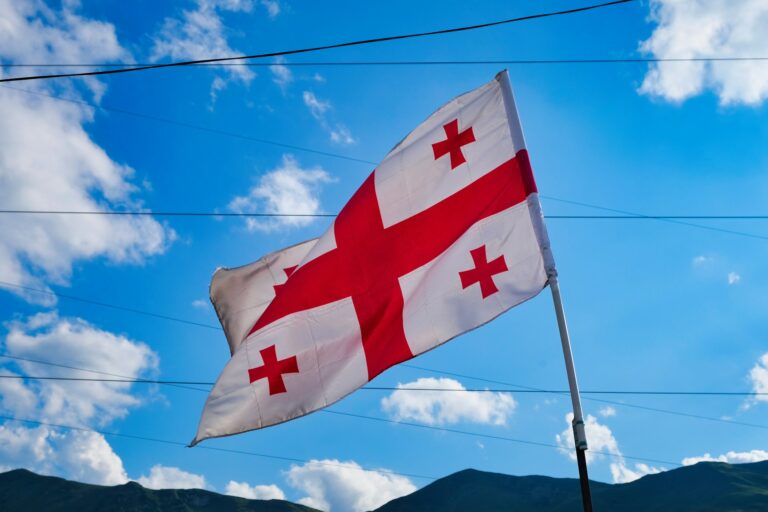
Georgia enjoys strong public support for the EU, yet in recent years, the country has experienced growing anti-Western rhetoric often used by the ruling political elite. This significantly challenges the relations and trust in Western institutions.
Georgia, a small South Caucasian country, has long been considered a leader in the European Union’s Eastern Partnership program. Over the past two decades, relations with Brussels have significantly deepened.
Georgia has secured a free trade agreement and visa-free travel for citizens holding biometric passports, while benefiting from sustained EU financial, political and diplomatic support. This includes consistent backing for Georgia’s territorial integrity, as 20 percent of its territory remains occupied by the Russian Federation.
Georgia’s current government, led by the Georgian Dream party, maintained largely stable relations with the EU for nearly a decade after coming to power in 2012. It positioned itself as pro-European in both domestic and foreign policy, while simultaneously pursuing what it described as a policy of “not irritating Russia,” which emphasised largely non-confrontational positions towards Moscow.
However, Russia’s full-scale invasion of Ukraine has significantly reshaped political rhetoric in Georgia, contributing to the rise of strongly anti-European messaging. Much of this messaging has been spread by major information outlets affiliated with the ruling party and known for their pro-government stance.
The narratives circulating among the public increasingly mirror patterns common in Russian information campaigns, at times echoing similar discursive frames and messaging strategies. This article outlines the core narrative and messaging strategies that have gained special strength in Georgia after the full-scale invasion of Ukraine.
The anti-European turn, accompanied by intensified disinformation and propaganda efforts linked to shifting geopolitical dynamics, as well as continuing undemocratic decisions at the legislative and executive levels, has strained Georgia-EU relations.
Georgia is now a subject of growing scepticism, contributing to the suspension of several EU-funded initiatives and raising concerns about potential future restrictive measures, which will suspend the benefits, such as a visa-free regime, firstly for the decisionmakers, followed by ordinary citizens.
Post-2022 regional changes – Russia’s decreasing hard power influence
Russia’s influence in the South Caucasus has been strong for decades since the dissolution of the Soviet Union. The occupation of Georgian territories – Abkhazia and South Ossetia, the conflict in Karabakh, Armenia’s dependence on Russia due to its regional isolation, Russia’s influence on Azerbaijan, and later the introduction of a peacekeeping mission in Karabakh have enabled Moscow to maintain hard power in the region. Russia is also effectively using soft power measures, particularly by promoting ideological narratives targeting growing EU and NATO influences.
Russia’s influence in the South Caucasus has been strong for decades since the dissolution of the Soviet Union.
Russia’s invasion of Ukraine had significant implications for the South Caucasus. Azerbaijan was able to regain control over Karabakh in 2023. The Karabakh region has been a source of conflict between Armenia and Azerbaijan since the early 1990s.
After the outbreak of second Karabakh war in 2020, Russia deployed a peacekeeping mission in the region, which proved unable to effectively monitor the ceasefire between Armenia and Azerbaijan and in 2024 withdrew from the region. Considering the shifting regional realities, Armenia has started deepening its connections with the EU, attempting to balance Russian influence.
Altogether, these developments have left Russia with decreasing hard power influence in the region. However, this has opened space for informational influence strategies. Ironically, Georgia, the country that has historically been the most pro-European in the South Caucasus, appeared particularly vulnerable during this period to such campaigns, especially those targeting pro-Western and particularly pro-EU views.
Georgia’s vulnerability and echoes of Russian rhetoric
As mentioned, for almost a decade the Georgian Dream ruling party’s foreign policy has been based on balancing between the West and Russia. For years, this approach was communicated to the public as a pragmatic strategy, given Georgia’s geographic position and the continued military threat from Russia.
However, in parallel, over the last decade Georgia has also opened space for groups, media outlets and political actors using more radical rhetoric, sometimes openly pro-Russian.
Examples of these include far-right political actors such as the Alliance of Patriots, Alt-Info, and television channels that have been promoting anti-EU narratives. In their discourse, these actors have often attempted to shift public attention away from Russian threats toward vaguer concerns, such as the need to protect Georgian identity from foreign, primarily Western negative influences, including what they describe as “LGBTQI propaganda.” These actors have at times been regarded as informal “satellites” of the government, voicing messages that the authorities themselves were still avoiding publicly.
However, since Russia’s full-scale invasion of Ukraine in 2022, the government itself has moved to the forefront of Euroscepticism, and at times openly propagandistic rhetoric. Recent trends indicate a shift toward clearly anti-Western, and occasionally hostile, messaging. The narratives have also increasingly portrayed Ukraine, historically a key partner of Georgia, as a negative actor.
Many of the messages constantly circulating among the Georgian public and supported by the government, echo Russian rhetorical patterns, particularly in their portrayal of the EU as a threat.
In some cases, Ukrainian leadership has been framed responsible for failing to prevent Russian aggression, while similar arguments have been extended domestically by accusing Georgia’s previous government of provoking Russian aggression in 2008. The launch and completion of a parliamentary investigation in relation to the 2008 war has further been used to reinforce these narratives and provide them with greater political legitimacy.
Many of the messages constantly circulating among the Georgian public and supported by the government, echo Russian rhetorical patterns, particularly in their portrayal of the EU as a threat and in their aim and ability to generate suspicion and confusion among the public. This has long fueled concerns about Georgian Dream’s potential ties to Russia.
At the same time, some observers argue that the party and its founder, oligarch Bidzina Ivanishvili is primarily driven by own economic and security interests, while strategically using well-established informational mechanisms to maintain political power.
Core narratives
In the Georgian case, social media does play a significant role in spreading anti-Western narratives, but reports show that traditional actors still play a significant role, like political figures and parties. Traditional media remains key too, with the most influential TV channels widely seen as supporting the government and actively deploying the same messaging.
This is especially relevant for reaching populations living outside the capital, in regions where these TV channels are sometimes the only source of information. It is interesting to note that, UK has already sanctioned Imedi and Postv channels, widely believed to be pro-governmental, by the end of February, for spreading misleading information about Russia’s war in Ukraine.
Many of these narratives repeat ideas and messaging that originate in Russian information campaigns and comparisons are provided to illustrate these parallels.
The data from several reports by different international and local organizations in Georgia, as well as limited number of academic publications on this topic suggest the existence of key narratives since 2022, that have been actively promoted among the Georgian public, both by the government and by satellite actors operating within the country.
Some key examples are outlined below. Many of these narratives repeat ideas and messaging that originate in Russian information campaigns and comparisons are provided to illustrate these parallels.
Georgian Sovereign Democracy
“Sovereign democracy” is a well-known Russian concept used to describe the governing model promoted by the Russian state. In simple terms, it can be understood as democracy practiced on a country’s own terms.
At the same time, Russian officials have consistently argued that their system is equal to, or even superior to Western democratic models. A key characteristic in this concept is that criticism of the system is often portrayed as suspicious or hostile, with critics frequently labeled as foreign agents, unfriendly actors or political enemies.
In recent years, similar messaging has played a key role in government rhetoric and among supporters of the Georgian authorities, particularly regarding EU political influence. The core argument suggests that Georgia no longer needs advice from its European partners on how to build democracy, while simultaneously promoting the view that Georgian democracy and the rule of law are in better condition than in parts of Europe.
Legislation supporting these restrictive practices has often been described by the ruling party as analogous to laws in the United States or Europe.
This messaging became especially dominant since November 2024, when the Georgian government decided to pause EU accession talks. The decision was followed by mass protests that continue daily across Georgia, as well as large-scale government suppression targeting civil society, opposition groups and independent media.
Legislation supporting these restrictive practices has often been described by the ruling party as analogous to laws in the United States or Europe. However, the European Commission has issued critical reports on these developments, portraying them as a serious threat to Georgia’s democratic future.
The narrative that “Georgia does not need advice on democracy,” often reinforced through selectively presented or manipulated examples of police misconduct, corruption or governance failures within the EU, closely resembles the Russian concept of “sovereign democracy,” which has long been used to shape public perceptions and justify political violence.
Stability vs. Ukrainisation
The narrative portraying Georgia as a “land of peace and stability under the Georgian Dream” government has been one of the most prominent since Russia’s full-scale invasion of Ukraine. It has been used to support the argument that Georgian Dream has saved the country from opening a so-called “second front” against Russia, while claiming that the collective West has been pressuring Georgia to do so, often through the vague notion of a “global war party.”
This messaging became particularly intense ahead of the 2024 parliamentary elections, aiming to instrumentalise societal fears of war in a country that has experienced several internal and external conflicts over the past 35 years.
The narrative has been closely linked to developments in Ukraine, promoting the perception that the West seeks Georgia’s “Ukrainisation” by opening a second front, while portraying the ruling party as the only political force capable of preventing such a scenario.
The broader practice of shaping public opinion against the collective West has often been identified as a well-established Russian strategy, in which conspiracy theories play a central role.
A particularly visible illustration of this messaging appeared in Tbilisi and other parts of Georgia ahead of the 2024 elections, where campaign banners displayed images of destroyed Ukrainian cities alongside images of peaceful Georgian landscapes. The campaign provoked strong critical reactions in Ukraine as well.
The broader practice of shaping public opinion against the collective West has often been identified as a well-established Russian strategy, in which conspiracy theories play a central role. The conspiracy narrative surrounding a so-called “global war party,” portraying Western governments and European institutions as opponents for the peace in Ukraine, has also been widely used in official Russian rhetoric.
Similar messaging patterns have appeared in Georgian political discourse, leading many researchers and practitioners to argue that Georgia is currently experiencing extensive, multi-level Russian influence operations, including efforts to shape public perceptions through disinformation and propaganda.
EU as the enemy of Georgian traditions
One of the most established anti-European narratives in Georgia has targeted Euro-integration by claiming that EU membership would destroy Georgia’s cultural identity and traditions.
This narrative has been particularly promoted by groups such as Alt-Info and similar actors that position themselves as defenders of Georgian traditions. Their rhetoric is often characterized by extreme right-wing views combined with religious arguments suggesting that opposing certain Western values is a moral and cultural obligation.
The narrative has specifically focused on sexual minority rights, claiming that EU membership would force Georgia to legalize same-sex marriage and allow Pride marches in the country.
Although other actors, including some religious figures have also contributed to spreading these messages, one of the most influential promoters of this discourse has recently been the government itself, which has emphasized “family sanctity” as a core national value while introducing restrictive legislation targeting sexual minorities.
Although public support for EU membership in Georgia remains consistently high, the persistence of Russian informational influence continues to present a significant challenge.
This approach is not unique to Georgia, as restrictive policies and rhetoric targeting sexual minorities have long been present in Russia. What is particularly notable, however, is that several studies indicate that Russia has systematically promoted such narratives through various channels, while supporting groups that adapt and localize these messages.
The broader objective of this strategy is to create distorted perceptions of Europe, undermine trust in European institutions and foster skepticism toward Euro-integration. Although public support for EU membership in Georgia remains consistently high, the persistence of Russian informational influence continues to present a significant challenge.
Impact on perceptions, Euroscepticism and EU-Georgia relations
The most critical question is: what impact do these information campaigns have on Georgian people’s perceptions of the collective West, and on the country’s aim to join the EU? As noted above, support for European integration remains strong among the Georgian public, with almost three-quarters of the population still supportive.
However, a closer look at surveys over the years reveals a noticeable decrease in positive perceptions and trust toward the EU in the last two years alone. EUNeighbours East has been producing annual survey results on the EU’s image and trust in Georgia, and comparing the reports from 2023 and 2025 clearly shows a drop of more than 10% in both categories.
The most critical question is: what impact do these information campaigns have on Georgian people’s perceptions of the collective West, and on the country’s aim to join the EU?
It is reasonable to consider that information campaigns influence public opinion and trust. Constant campaigns, originating from influential sources can succeed in creating confusion and prompting people to question previously held beliefs, eroding trust in the EU and in the long term, potentially decreasing support for integration.
The undemocratic tendencies and continued anti-EU rhetoric have left their mark on Georgian-EU relations. The European Union has repeatedly warned Georgian authorities that continuing this path will ultimately undo all the positive developments achieved over the years under different administrations.
The EU has also expressed concerns about anti-Union narratives in recent years. Georgia’s candidate status is currently largely symbolic, and the accession process is effectively frozen. The EU warns that it will remain so until the ruling party reverses course.
Concerning shifts and geopolitical influence through informational and ideological channels
The growing similarities between Georgian government messaging and narratives long associated with Russian informational strategies highlight a concerning shift in Georgia’s political and communicative landscape. Russian-style anti-Western rhetoric by ruling political figures and influential media, conspiracy theory-driven messaging, and hostile identity-based narratives have affected public trust in Western institutions and complicated Georgia’s relationship with the European Union.
These developments demonstrate that geopolitical influence in the South Caucasus is no longer exercised primarily through military or economic leverage, but increasingly through informational and ideological channels.
Georgia’s case also illustrates how external narratives can be localised and adapted to domestic political agendas, particularly during periods of geopolitical instability and societal vulnerability.
Georgia’s case also illustrates how external narratives can be localised and adapted to domestic political agendas, particularly during periods of geopolitical instability and societal vulnerability. The persistence of strong public support for EU membership suggests that Georgia’s European orientation remains continuous and deeply rooted. However, the continued use of anti-European discourse increases the risks of gradually reshaping public perceptions.
Understanding these dynamics is essential not only for Georgia’s democratic future but also for broader European engagement in the region. Addressing information influence operations within the context of Russia’s shifted regional strategies will remain critically important regarding Georgia and its European trajectory.
Nino Chanadiri is a political science researcher and analyst specialising in Eastern Europe and the Baltic Sea region. For years, she has contributed analytical and research-driven content to reputable organisations and journals in Georgia, Estonia and Poland, focusing on socio-political developments in South Caucasus, wider Eastern Europe and Baltic Sea region.
Article image: Etienne Dayer / Unsplash